Coyote crosses first on $114 million wildlife bridge over 101
A single animal confirmed the new Agoura Hills structure is functional months before its official opening, setting the stage for vital genetic studies.
By Allison Rojas ·
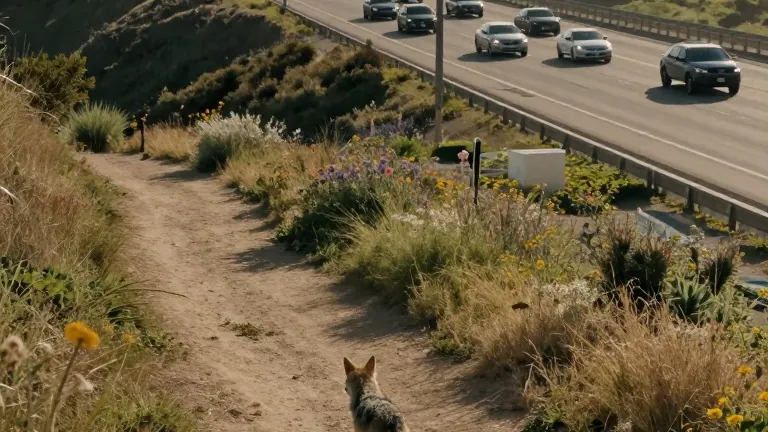
A coyote stepped onto the new dirt mound in Agoura Hills on Wednesday, becoming the first large mammal to use the Wallis Annenberg Wildlife Crossing. This early test confirms that the massive structure over the 101 Freeway is already functional, despite not being fully finished.
The animal was captured on camera shortly after 6 a.m. by a device installed on Oct. 14. The black-and-white image showed the coyote heading up the hill, with only its eye reflecting the light. The National Park Service shared the footage publicly on the same day.
This early activity is a positive signal for the project, which faces a strict Dec. 2 opening date. The bridge is designed to connect two overpasses, one for the freeway and one for an adjacent road. However, the coyote could not complete the journey because the soil connecting the two structures was not yet built high enough.
Crews are now working to raise the grade of the slope. Once the soil is seamless, larger animals such as mountain lions and bobcats will be able to cross the entire length of the structure. This physical change is necessary for the bridge to serve its primary ecological purpose.
Beth Pratt, president of the Wildlife Crossing Fund, said she urged NPS biologist Jeff Sikich to install the camera. She described the process of pestering him with daily texts until the equipment was placed. "Oh my God, it’s already working," Pratt said upon seeing the initial footage.
Sikich rushed to the site on Tuesday to install six additional cameras on the crossing itself. Remote monitoring is a core part of the plan. The final setup will include more than 50 still cameras and four thermal video units. While the footage will not be streamed live, the data will be made available to the public.
The project has faced political backlash and weather delays. Now, winter storms are the only remaining threat to the Dec. 2 deadline. The roughly $114 million structure is intended to solve a long-standing isolation problem for local wildlife.
Scientists have studied the area since 1996. They began radio collaring bobcats and coyotes in Liberty Canyon that year and extended the research to mountain lions in 2002. The team is now deploying GPS trackers on carnivores, deer, and gray fox to map their movements.
Researchers are also implanting biologgers into deer and soon mountain lions. These devices track physiological data such as body temperature, heart rate, and fat reserves. This data will help scientists assess how animals react physically to crossing the freeway.
The genetic stakes for the local mountain lion population are high. Close relatives have been mating for years, leading to inbreeding defects such as kinked tails and deformed testicles. A single new lion entering the area to breed could significantly alter the genetic makeup of the population.
A camera near the southern end of the crossing has already captured a mountain lion with two kittens and another uncollared lion in less than two months. Pratt described seeing these photos as a poignant moment. She said the project addresses a specific problem by providing a safe passage that reduces the risk of animals being hit by cars.
"We’ve been spending decades, literally decades, documenting how wildlife has become isolated in the Santa Monica Mountains, and what makes us scientists excited is now we have this opportunity to study what happens when we reconnect it," Sikich said.