Governors in Six River States Face Elections Amid Water Stalemate
Midterm races in the Colorado River Basin feature partisan attacks, but experts say the resulting leadership changes may not alter the states' rigid positions on water allocation.
By Amelia Gupta ·
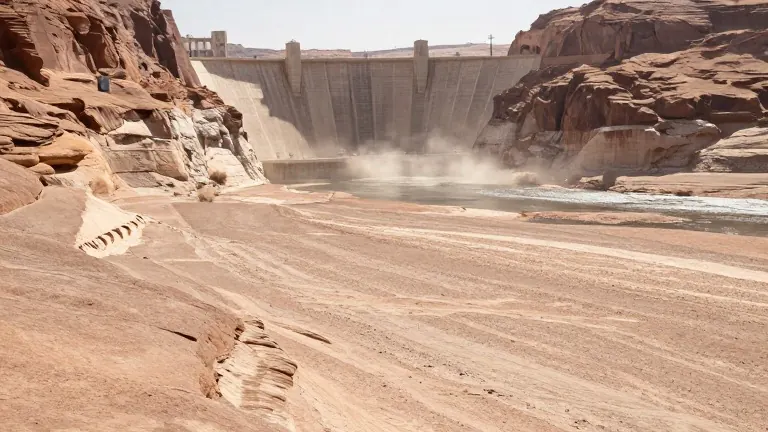
Six of the seven states that share the Colorado River will elect their governors in the upcoming midterm elections. The races feature sharp partisan exchanges over how the water is managed, yet analysts suggest the outcomes are unlikely to shift the fundamental dynamics of the regional water crisis. In Nevada, Democratic candidate Aaron Ford, the state’s attorney general, accused Republican incumbent Joe Lombardo of botching negotiations. In Arizona, Republican challenger Andy Biggs claimed that Democratic Governor Katie Hobbs cost the state millions of gallons of water.
The Trump administration joined the political fray by accusing Governor Hobbs of playing politics rather than seeking solutions. This critique followed Arizona’s decision to join Nevada in a lawsuit against the federal government’s new framework for river management. Neither Ford’s nor Biggs’s campaigns responded to requests for comment regarding these accusations.
The current political landscape in the basin is defined by a federal 10-year framework for water cuts. This plan was imposed after years of failed negotiations among the seven states. The allocation reductions apply exclusively to California, Arizona, and Nevada, the Lower Basin states. Nevada and Arizona have sued the Department of the Interior over this plan. A larger lawsuit involving all seven states remains a possibility due to disagreements over key clauses in the interstate compact.
Negotiations have stalled because the Upper and Lower Basins disagree on the size of necessary cuts and which states must absorb them. The Lower Basin, which historically overused its allotment, proposes taking less water under specific drought conditions. The Upper Basin, which has never used its full share, resists mandatory cuts. Officials in the headwater regions argue that hydrological uncertainty makes fixed reductions unworkable.
Polls indicate that most gubernatorial races will follow the states' current partisan splits. Xavier Becerra, the Democrat in California, is heavily favored over Steve Hilton. In Colorado, Democrat Phil Weiser leads Victor Marx. In New Mexico, Democrat Deb Haaland holds a comfortable lead over Gregg Hull. Republican Eric Barlow leads Kenneth Cassner in Wyoming. Ford and Lombardo are locked in a tight race in Nevada, while Hobbs holds a cushion over Biggs in Arizona.
Gary Wockner, founder of the environmental group Save the Colorado, noted that water politics are surprisingly nonpartisan. He said that regardless of the party in charge, leaders usually prioritize draining the river to the legal limit. Wockner has lived in the basin for 40 years and has sued to prevent Colorado from drawing more water. He observed that states in the Upper Basin, such as Colorado, New Mexico, and Wyoming, face no mandatory cuts under the new federal plan. Consequently, water has been a less prominent issue in those races.
In Arizona, the issue carries more weight. Polling from the Center for the Future of Arizona found that 69 percent of voters lack confidence in the state having enough water long term. Phoenix could lose its entire Colorado River supply in some scenarios under the federal plan. Despite this urgency, Sarah Porter, director of the Kyl Center for Water Policy at Arizona State University, said that lawmakers in both parties tend to adopt similar positions once in office. She noted that personal feelings among long-serving negotiators complicate the process.
Elizabeth Koebele, an associate professor of political science at the University of Nevada, Reno, described herself as more pessimistic than ever about the states reaching a consensus. Celene Hawkins, Colorado River program director at The Nature Conservancy, said newly elected officials will need to lower the temperature across the basin. She expressed hope for a commitment from elected leaders to find a long-term solution for a potentially hotter and drier future. A representative for Weiser’s campaign declined to comment, and a staffer for Barlow’s campaign did not respond to questions by publication time.