Wyoming drivers routinely pass nuclear missile components on Interstate 80
Semitrailer drivers and military officials confirm that convoys escorting Minuteman III missile parts travel on public highways, often without blocking traffic.
By Allison Rojas ·
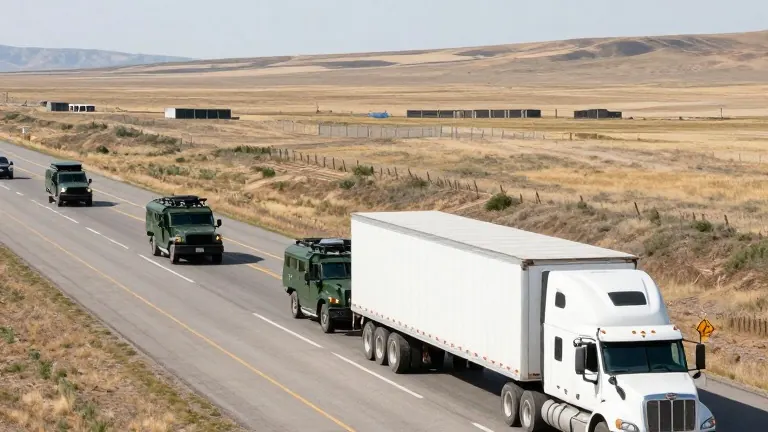
Highway traffic in Wyoming often flows past military convoys that transport critical parts of the nation's nuclear deterrent system. Semitrailer driver Roberto Figueroa witnessed one such movement in 2023 near Burns, Wyoming, while traveling on Interstate 80. He described a uniquely shaped tractor-trailer moving east toward Pine Bluffs, Nebraska, accompanied by local police, state police, and a white pickup truck. Figueroa noted that the formation resembled a presidential motorcade, yet regular cars and trucks continued to pass in the left lane without restriction.
The vehicle at the center of the convoy was a Payload Transporter III, a specialized one million dollar semitrailer built for the U.S. Air Force. According to the F.E. Warren Air Force Base website, this vehicle is designed to load, unload, and move Minuteman weapon system aerospace vehicle equipment. It transports components such as guidance systems, rocket engines, and reentry systems between launch facilities and missile support bases using air-cushioned pallets. The convoy was flanked by Lenco BearCat armored vehicles, which Figueroa observed were equipped with communication jammers rather than machine guns.
Tucker Fagan, the former commander of F.E. Warren Air Force Base, reviewed Figueroa's photographs and identified the vehicle. Fagan confirmed that the Payload Transporter III is distinct from the Safeguards Transporter, a highly secretive vehicle used specifically for moving nuclear warheads. The Safeguards Transporter, designed by Sandia National Laboratories, features twelve inch thick sides and automatic sanders to keep payloads level. Because the PT III is easier to identify than the armored warhead carriers, Fagan concluded that Figueroa was passing missile components rather than an active warhead.
Military officials maintain a policy of not confirming or denying the presence of nuclear weapons in specific locations. Fagan explained that this approach protects national defense interests and manages public perception. He noted that the American public often reacts with fear to anything associated with nuclear technology. This sentiment is evident in local opposition to nuclear projects, such as a microreactor manufacturing facility proposed near Bar Nunn. The infrastructure supporting underground missile silos remains visible across Wyoming, Nebraska, Colorado, and Montana, though it often goes unnoticed by the general public.
The U.S. Air Force is currently replacing the aging Payload Transporter III fleet. In April, the 341st Maintenance Group completed the first operational mission for the new Payload Transporter Replacement at Malmstrom Air Force Base in Montana. The Air Force has ordered 25 of these new vehicles, which feature armored cabs and enhanced trailers. These replacements will likely serve only temporarily, as the entire Minuteman III fleet of 450 missiles is scheduled for decommissioning. Northrop Grumman is manufacturing the LGM-35 Sentinel missiles, which will occupy the same silos, at a total cost of 141 billion dollars.
The Air Force plans to hold town halls for Wyoming residents to discuss the transition to the Sentinel Program. These meetings are scheduled for November 30 in Cheyenne and December 1 in Torrington. Figueroa, who now understands the significance of his 2023 encounter, recalls feeling a mix of terror and excitement while passing the convoy. He described the experience as driving around the world's most dangerous weapon while maintaining a normal pace of traffic.
Fagan emphasized that highway transport of nuclear assets is a standard procedure that has continued since the 1960s. The Department of Energy manages the transport of payloads, while the Air Force oversees the missiles themselves. The visual presence of these convoys serves as a constant, if quiet, reminder of the infrastructure supporting the United States' intercontinental ballistic missile program.