Humanoid Robot Delivery Slips to Late 2027 as Hardware Issues Persist
Tesla's plan to deliver Optimus robots to outside customers has been delayed to late 2027, with ongoing issues related to hand durability, reliability, and artificial intelligence.
By Allison Rojas ·
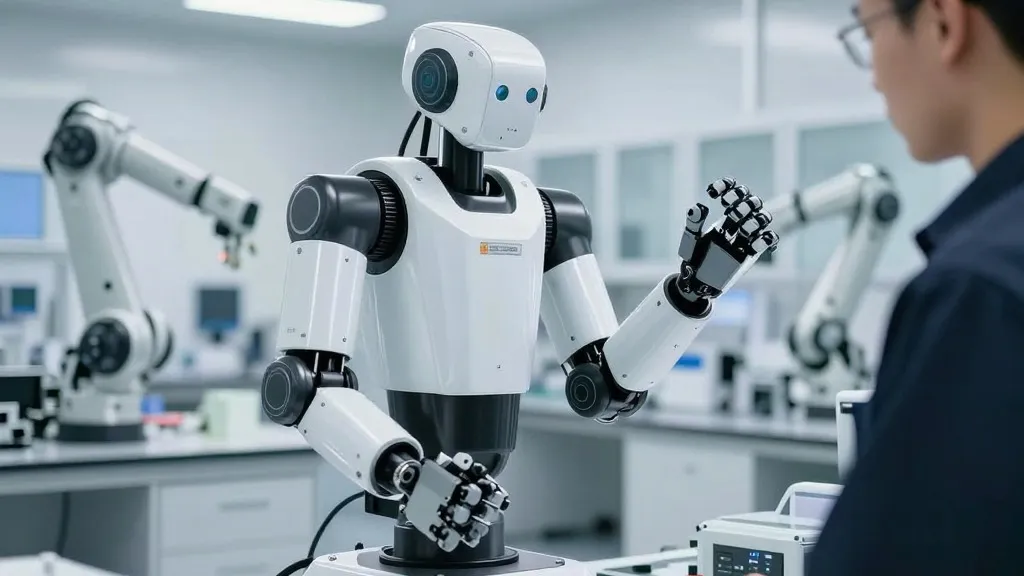
Tesla's plan for delivering its Optimus humanoid robots to external customers has been pushed to late 2027, according to CEO Elon Musk. He disclosed the new timeline during the company's Q3 2026 earnings call. The delay is attributed to unresolved challenges with the robot's hands, its durability, and its AI capabilities.
Musk stated that Tesla has begun early production of Optimus on a high-volume line in Fremont, California, where Model S and Model X vehicles were previously built. While most of a line designed for an annual output of one million robots is installed, reaching the target rate of approximately 20,000 units per week will take at least a year, potentially longer. This is because parts of the robot's design are still being modified.
The key issues to be resolved before external deliveries can begin include the AI, the electromechanical design, and overall reliability. Musk specified that a primary concern is ensuring the robot's durability, for example, that it does not wear out after a month of use. He anticipates these problems will be addressed by the end of next year, at which point Tesla will begin delivering Optimus units to companies for industrial jobs that are dangerous, repetitive, or require round-the-clock operation.
During the call, a Tesla Optimus engineer identified the hand as a particularly difficult hardware area, alongside custom gears that raise reliability concerns. Musk concurred that the hand is the main issue. He explained that the fingers must be soft enough to handle delicate objects yet durable enough to withstand constant wear, noting that unlike human skin, the robot's components cannot heal.
On the AI front, Musk acknowledged that Tesla is still working through problems with its architecture. A significant hurdle is that Tesla does not have a fleet of robots collecting data in the same way its vehicles do for Full Self-Driving (FSD). To address this, the company plans to produce between 10,000 and 20,000 robots to perform tasks in what it calls an Optimus Academy. Additionally, Tesla intends to install its AI5 chip in the Optimus robot around April 2027.
Musk also promised a video of Optimus performing tasks that are not pre-programmed within a month or two. He argued that many humanoid robot demonstrations are scripted routines that would not function in real-world scenarios. This request for a demonstration of generalization comes as Tesla's own Q3 shareholder letter now describes the units coming off the Fremont line as the first production-quality bots it has manufactured, implying earlier versions were not.
The timeline for Optimus has been revised multiple times. In 2024, Musk stated that Tesla would build Optimus for internal use in 2025 and for other companies in high volume in 2026. In January 2025, he said Tesla would build about 10,000 robots that year, with several thousand performing useful work by year-end, a goal he later admitted was not met. The current target for external deliveries is now late 2027.
Musk's claim on the call that no one is close to Tesla on general-purpose humanoid robots is difficult to reconcile with the public activities of competitors. XPeng turned on an automated production line for its IRON robot in Guangzhou in September, with over 80% of core processes automated. XPeng plans mass production by the end of 2026 and deliveries in the first half of 2027, a timeline similar to or slightly ahead of Tesla's.
Boston Dynamics, a Hyundai subsidiary, started producing its electric Atlas robot in January and reports that all of its 2026 deployments are committed. In September, it opened a robot training center at Hyundai's Metaplant in Georgia, where Atlas is learning to sequence car parts for the assembly line. Hyundai plans to deploy 25,000 robots across its plants over the next few years. Boston Dynamics has also taken a different approach to the hand problem, prioritizing sturdy grippers for industrial parts over human-like dexterity, a strategy that sidesteps the specific challenge Tesla identifies as a primary obstacle.
Tesla faces the same fundamental challenges as its competitors: creating hands that can survive real-world work, ensuring robots are reliable enough to be cost-effective, and developing AI that can handle tasks for which it was not explicitly trained. The company's competitors are not telling investors they have no competition, and Boston Dynamics is already deploying its robot in a car factory with committed customers. While Tesla may have built more robots, the challenge lies in making them useful.