Iran reports three tankers hit by mines in Strait of Hormuz
The Revolutionary Guard says vessels ignored warnings while using a restricted route, complicating shipping traffic as Israel awaits final election counts.
By Allison Rojas ·
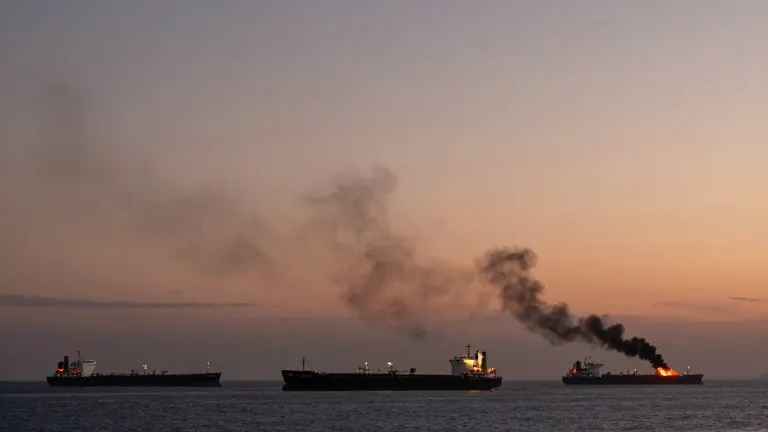
The Strait of Hormuz, a critical chokepoint for global oil trade, saw a sudden spike in maritime incidents as Iran reported a string of explosions. On Thursday, the Iranian state broadcaster announced that three oil tankers struck naval mines and caught fire within the past 24 hours.
The Revolutionary Guard Corps stated that the vessels attempted to exit the waterway through an unauthorized route. According to the navy, the tankers switched off their radar and navigation systems and ignored warnings from authorities. The damaged ships were left abandoned off the southern coast of the strait. The report did not identify the specific vessels or confirm any casualties, and the Associated Press could not immediately verify the claims.
A British military monitor provided a partial confirmation of the chaos in the waterway. The United Kingdom Maritime Trade Operations Center noted that a vessel spotted another ship on fire while transiting the strait on Thursday. Officials at the center said they did not know the status of the crew or the extent of the damage to the burning vessel. It remained unclear if that specific ship was one of the three mentioned by the Iranian guard.
Tensions in the region have risen due to fears that U.S. and Israeli attacks on Iran could resume. Despite the recent increase in attacks, tankers have continued to move oil through the strait under U.S. military protection, according to data from Lloyd’s List Intelligence. Iran insists that ships must communicate with its authorities and follow designated paths, warning that other routes are mined.
In Israel, voters are still waiting for final election results that could be announced as early as Thursday evening. Projections suggest that neither Prime Minister Benjamin Netanyahu’s bloc nor the opposition, including Arab-led parties, will secure the 61-seat majority needed to form a government. Local media estimates put Netanyahu’s bloc at 53 seats, opposition parties at 48, and Arab-led groups at 19.
Uncertainty deepened after allegations of foreign interference emerged. The head of the Central Elections Committee asked the Shin Bet intelligence service to investigate claims of funding by foreign entities against Israeli interests. The letter, dated Wednesday, did not specify who made the allegations. Netanyahu quickly used the request to argue that no party should cooperate with Arab-led groups, a claim the original letter did not make. Israeli law requires results to be certified by Nov. 4.
In Yemen, the Houthi-run Health Ministry said a Saudi strike killed 12 people and critically wounded three others, including women and children, in the city of Taiz. The ministry blamed the attack on two homes belonging to the same family. A separate strike hit a paint factory late Wednesday, causing a large fire that could release toxic gases into the soil and groundwater, according to Yemen’s National Human Rights Authority. The province has been a contested front line between the Houthis and government forces.
In Gaza, an Israeli strike on a civilian vehicle in the central enclave killed two people and wounded another on Thursday, according to health officials at Al-Aqsa Martyrs Hospital. The Israeli military did not respond to a request for comment. The death toll in Gaza has risen steadily since the fragile ceasefire began in October 2025. The territory’s Health Ministry reports that more than 1,550 Palestinians have been killed by Israeli strikes since the truce began, though it does not distinguish between civilians and fighters.